
In the fast-paced world of digital commerce, accurate demand forecasting and efficient inventory management are critical to success. Traditional methods often fall short of meeting dynamic customer demands and supply chain complexities. This is where artificial intelligence (AI) comes into play.By harnessing AI techniques, businesses can revolutionize demand forecasting and inventory optimization, leading to streamlined operations and maximized profitability. In this article, we will explore the benefits, challenges, and best practices of implementing AI for demand forecasting and inventory optimization in digital commerce.
AI Benefits in Demand Forecasting and Inventory Optimization
Implementing AI solutions for demand forecasting and inventory optimization brings numerous advantages for businesses:
Improved Accuracy
AI algorithms, powered by machine learning, can analyze vast amounts of historical data and identify patterns, resulting in more accurate demand forecasts. This precision minimizes stockouts and lost sales. For example, AI-powered forecasting tools can combine data from sales history, weather forecasts, upcoming holidays, and other market indicators to create more accurate projections of future demand.
Enhanced Visibility
AI provides valuable insights into customer demand patterns, allowing businesses to understand buying behaviors, trends, and seasonality. Visibility enables proactive planning and improved decision-making. For instance, AI can provide insights into customer preferences to help businesses plan for future product launches and develop marketing campaigns tailored to target customers.
Efficient Inventory Management
AI-driven optimization models optimize inventory levels by considering multiple factors such as lead time, costs, and customer demand. This leads to reduced holding costs, optimized order quantities, and improved inventory turnover. For instance, AI-driven inventory management can help identify patterns in customer demand, reducing the quantity of overstocks and understocks, and helping businesses reduce the costs associated with carrying extra inventory.
Minimized Stockouts
By accurately predicting demand, AI solutions help prevent stockouts, ensuring products are readily available to meet customer needs. This improves customer satisfaction and protects revenue streams. For instance, AI-driven demand forecasting can help ensure the right inventory levels are maintained in warehouses and stores, reducing the risk of out-of-stock situations during peak seasons or product launches.
Increased Profitability
AI empowers businesses to optimize pricing and promotions by analyzing demand patterns, competitor pricing, and market dynamics. This strategic approach boosts profitability and maximizes revenue potential. For example, AI-based pricing tools monitor market conditions in real-time and automatically adjust prices so retailers can capture the maximum value of each sale.
Understanding AI Techniques for Demand Forecasting and Inventory Optimization
To effectively implement AI for demand forecasting and inventory optimization, businesses need to know key AI techniques:
Machine Learning Algorithms
Machine learning algorithms, such as regression, time series analysis, and neural networks, learn from historical data to predict future demand patterns. These algorithms adapt to changing trends and improve accuracy. By analyzing data from past events, machine learning algorithms can identify patterns and help predict future events with greater accuracy. This helps businesses make better decisions and improve their operations. Additionally, the algorithms are constantly learning and adapting to new trends, meaning they are always getting more accurate.
Predictive Analytics and Pattern Recognition
Predictive analytics uses historical and real-time data to identify patterns, correlations, and anomalies. By leveraging pattern recognition techniques, businesses gain actionable insights for demand forecasting and inventory planning. Predictive analytics is a powerful tool to improve the efficiency of supply chain operations. It helps to identify high-risk areas, reduce wastage, and optimize inventory levels. By leveraging the power of pattern recognition, businesses can detect potential problems before they arise and take preventive measures to mitigate risk.
Optimization Models
Optimization models utilize mathematical algorithms to determine optimal order quantities, reorder points, and safety stock levels. These models balance service levels and inventory costs, considering variables like lead time, demand variability, and stockout risks. By simulating various scenarios, optimization models are able to identify the best combination of inventory levels that will minimize total inventory costs while maintaining service levels. This helps businesses make more informed decisions about their inventory levels and helps them minimize costs without sacrificing customer satisfaction.
Real-time Data Analysis
Incorporating real-time data, such as sales data, customer behavior, and market trends, allows businesses to make timely inventory adjustments, respond to demand fluctuations, and optimize supply chain operations. Identifying opportunities or problems in real-time allows companies to take corrective action quickly. This ensures that they are always up-to-date on what is happening in the market, which allows them to make more informed decisions and remain competitive.
Data Preparation and Integration for AI Implementation
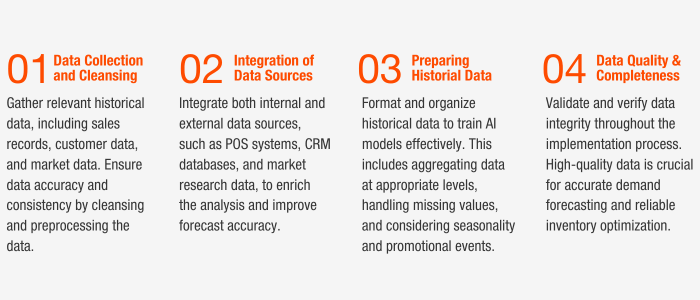
Successful implementation of AI for demand forecasting and inventory optimization relies on proper data preparation and integration:
Factors to Implementing AI for Demand Forecasting
- Selecting Appropriate Machine Learning Algorithms: Evaluate different machine learning algorithms, such as ARIMA, LSTM, or random forests, and choose the ones that will suit your specific demand forecasting needs. For instance, ARIMA is suitable for analyzing time-series data and has a low model complexity, while LSTM is suitable for analyzing text data and provides more accuracy, but may require more resources to run. Consider factors such as data characteristics, model complexity, and interpretability.
- Training AI Models: Training AI models using historical data, incorporating relevant factors like seasonality, promotions, and external events. Use cross-validation techniques to validate model performance and ensure accuracy.
- Validating and Fine-Tuning Models: Validate AI models using real-time data to assess their performance in real-world scenarios. Fine-tune models based on feedback and continuous learning, adjusting to improve accuracy and adapt to changing demand patterns.
- Integrating AI-Driven Demand Forecasts: Integrate AI-driven demand forecasts into operational processes such as production planning, inventory management, and procurement. Ensure seamless communication and collaboration across departments to align supply with predicted demand.
Key Points to Optimizing Inventory with AI
- Utilizing Optimization Models: Employ optimization models that consider factors such as demand variability, lead time, service level targets, and cost constraints. These models determine optimal order quantities, reorder points, and safety stock levels to achieve a balance between customer service and cost efficiency.
- Dynamic Demand Adjustments: Apply AI algorithms to dynamically adjust inventory levels based on real-time demand patterns, market dynamics, and changing customer behaviors. This adaptive approach helps optimize stock levels and minimize excess inventory or stockouts.
- Trade-off Analysis: Leverage AI-driven trade-off analysis to understand the impact of inventory decisions on service levels, costs, and customer satisfaction. Analyze different scenarios and make informed decisions that align with business goals. For instance, the trade-off analysis could be used to compare the cost of maintaining higher inventory levels with the cost of lost sales due to stockouts.
- Continuous Inventory Optimization: Utilize real-time data and AI capabilities to continuously monitor inventory performance and make necessary adjustments. Regularly review and optimize inventory policies to adapt to changing market conditions and customer demands.
Streamline Operations and Maximize Profitability
In the digital commerce landscape, AI solutions for demand forecasting and inventory optimization are game-changers. While this technology provides significant benefits for companies, it also poses challenges. Contact Echidna for help navigating today's competitive digital commerce environment if your organization is looking to leverage artificial intelligence to streamline operations, meet customer expectations, and maximize profitability.Contact Us